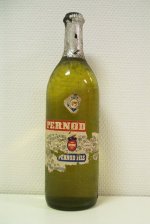
After the ban of absinthe started spreading all over the world from 1910 and on, the distillers, and the drinkers had to turn to something else. The producers started to make products that reminded of absinthe, but conformed to the new laws and regulations. Among those products were various Liqueurs d'Anis, Pastis and so on. Some of the brands still exist today, some not. The ones reviewed in this section are vintage absinthe substitutes.
Pernod Fils Pastis (1955)
France, 45% alc. vol. (90 proof), 1.0 liter
At the same time as this was being produced in France, a spanish distillery had licensed the rights to make Pernod Absinthe, in Tarragona. That makes this quite interesting, since there are lightyears between the two products. This pastis is no where near the absinthe from the same time. So, my first thought was - how would this vintage Pernod pastis compare to modern Pernod pastis? This called for a side-to-side tasting.

I opened the bottle, and the smell reminded a lot of modern pastis. Or, should I say it was identical? The only difference was that it smelled a little more toned down on the anis, compared to the modern one, however I think that is due to the ageing. I poured some in a glass, and put that next to a glass of modern Pernod. It looks exactly the same. No difference what so ever. Final step before tasting is ofcourse to add water. The 1955 Pernod Pastis produced a louche identical to the modern. And yes - they taste just the same. There is virtually no difference between the two. Am I dissapointed? In a way maybe, but on the other hand it's quite nice to see that the product of today is just as "good" as the product 60 years ago. Why would they change a winning concept? The dissapointment lies in the fact that I had hoped for this to be at least a bit different from what we can buy today.

View additional photos: 01 |

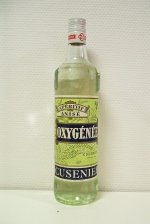
Cusenier Oxygénée Anisé - Substitute (circa 1960)
France, 42% alc. vol. (84 proof), 1 liter
I recently purchased a full bottle of the Oxygénée Anisé Aperitif from around 1960. Even though I know, from previous sampling that this is not a very good drink, it was nice to find and add to the collection. This is why I have updated this with new photos. The review, below, is the same as before.

First of all, the Oxygénée Anise is not an absinthe. It is an anise substitute produced by Cusenier after the ban of absinthe in France. It is totally clear, and smells heavily of anise. The anise smell is so dominant that I found it very hard to detect anything else. Tasting it neat gave a very distinct anise flavour mixed with a rather smooth light burn from the lower alcohol level. But there is nothing else there. Adding water to it, produces a nice enough louche, but the drink itself is still not very good. It is a shame that a brand known for its exquisite absinthe, turns to this. The modern Oxygénée "absinthe" is actually, to me, a much nicer drink than this Oxygénée Anise. I only wish I would some day get the chance to taste the true Oxygénée Absinthe Hygienique.

View additional photos: 01 |

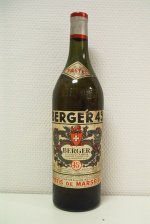
Berger Pastis 45 (ca 1937-1940)
France, 45% alc. vol. (90 proof), 1.0 liter
I had the pleasure of obtaining two bottles of ca 1937-1940 Berger Pastis 45 a while back. Berger was a well reputed brand of one of the finest absinthes before the ban, the 65% C.F Berger (read a review of the vintage Berger absinthe here). An absinthe that is now being reproduced by Jade Liqueurs (review of Jade reproduction here).

So then, how's the Berger Pastis? Well, it's a pastis so I expected it to be quite sweet, which it is. But it's not at all as sweet as the Pernod Pastis. I'd say it presents a little more spicey character than many other Pastis'. Of course it is packed with anise and licorice, but it's actually not as heavy as one might think.

As expected it presents a thick steady louche and after louching, it is actually very drinkable. I'd say this is one of the absolutely best pastis' I've had this far. The only downside is, that I know what the vintage Berger absinthe tasted like, and it's a true shame that this is what they had to turn to...

View additional photos: 01 | 02 | 03 | 04 | 05 | 06 |

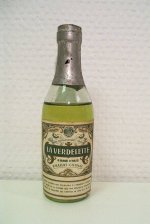
La Verdelette (circa 1925-1930)
France, 0.04 liter
For a long time I had one bottle of this but I didn't want to open it since it was in excellent condition. so, I recently got hold of another one and decided to give it a try. The first one I had, and still have, was a lot more greener and looked more like absinthe than the one I opened. This was a bit paler.

Considering that there was a few absinthes that even after the ban was known to actually be absinthes and not "modified" to fit the regulations and the text on the bottle "convincing" the government that this was indeed not an absinthe, one could believe that it actually was...
So, I extracted the contents of the bottle and poured them into a glass. It smelled very sweet and of course a lot of anise. From that I expected a quick and thick louche, but got nothing. The aroma only flattened and there was virtually no louche at all. The taste was nothing but very sweet and a bit of anise. Nothing else. I couldn't even find a remote bit of alcohol bite in it, so I poured the dilluted drink into a measuring glass and tested it with a alco-meter. It showed no alcohol at all. Hmmm. So, probably it was actually very low in alcohol from the beginning and wasn't meant to be "louched" at all.

I think there might be a difference between the two bottles, given the obvious difference in color, which is why I will eventually try the other one as well. However, for now - I will have to say that the Verdelette was a really sad experience and was nowhere near absinthe.

View additional photos: 01 | 02 | 03 | 04 | 05 | 06 | 07 | 08