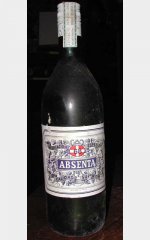
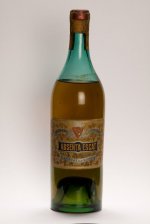
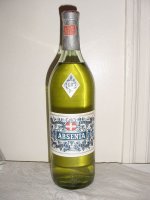
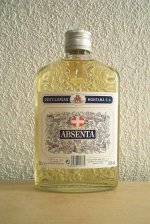
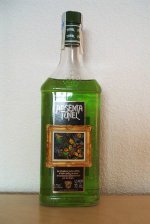
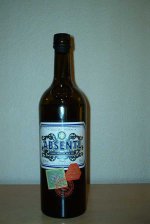
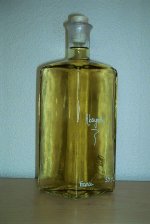
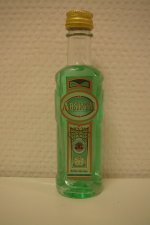
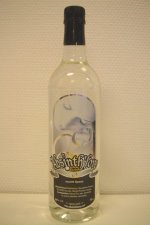
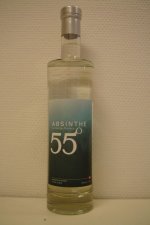
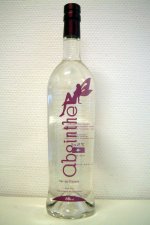
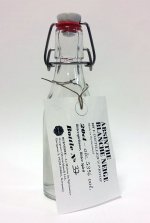
This section includes absinthes from a whole lot of countries. Each country ofcourse with it's characteristic adaption of absinthe. Portugal, for instance is known to have very harsh absinthes, with mainly the taste of alcohol. Then there's Denmark, with Kruts Karport, which was the only bar in Denmark allowed to sell and produce their own absinthe. In Sweden there is no commercial production at all, even though it was never banned in Sweden. Then again, absinthe was never really popular in Sweden either. Countries such as Italy and Bulgaria also produce absinthes, but they all lean towards Czech style. But ofcourse there must be something good coming out of other places than France and Switzerland. And yes, there is. Among some the Montmartre from Austria really stands out of the crowd and presents a really fine drink. Click the thumbnails to view larger versions of the photos.
Created: 4/22/2007  
Helfrich Verte
Netherlands, 68% alc. vol. (136 proof), sample
Mr Serge Helfrich has had an absinthe out on the market for a while now. I've tried the first version, I've tried a couple of "in between test runs" and now I got to try the version currently available. It has without a doubt been improved a lot since the last "public release"...

First of all it smells really nice and a complex herbal character presents it self. The very clear presence of nice fennel and wormwood is mixed with clear notes of citrus, mint and also coriander.

The color of the sample I had was a little less green than I had thought it would be but that could be just my sample having turned slightly "feuille morte". Not necessarily a bad thing but the color should be stable for a little longer than that. Adding water a nice and steady louche is slowly building up and at about a 3:1 water/absinthe ratio it's almost completely opaque. The drink has turned into a light green instead...

Again, the very clear citrus notes are up front and also the minty touch is enhanced. However, there's a certain lack of balance in it all. There's always something showing through a little too much. An otherwise rich and full mouth-feel is sadly distorted by some form of harsh strong herbal taste which takes away a bit of that creaminess. This same thing comes back in the taste, making it a bit too unbalanced. Sure, there are a lot of herbs and spices that aren't normally used in an ordinary absinthe so I don't expect it to be the same as everything else but this little something is the one thing that I don't quite like with it.

Other than that I must say that it's a quality product, no doubt. It's well made and it's been improved from previous runs and I am very sure that I will eventually end up loving it.

Created: 4/21/2007  
Apsinthion de luxe
Poland, 55% alc. vol. (110 proof), 0.5 liter
For us Swedes, Poland is mainly known for cheap labour and cheap booze. The first, and this far only, Polish absinthe is the Apsinthion de luxe which also is rather cheap. About 10-15 euros per bottle.

This fact runs through the entire experience of the drink and it's clear that cheap in this case definitely doesn't equal quality. The very artificially bright green color, even though less nuclear and blue than many others, is the first indicator on what this is likely to be. It reminds a lot of other similar product like the Trenet Premium, Hapsburg etc.

Opening the bottle which by the way is rather attractive with a nice label and all, reveals a very candy-like licorice smell right away. This is accompanied by the characteristic smell of wormwood oil (essences). Pouring a glass only opens up for more of that artificial candy-like smell and presents no complexity or pleasant surprises at all. Pouring iced water into it of course presents a quick and thick louche and also, during the pouring it holds a surprisingly fine thin layer on top until it's completely louched.

The drink ends up in a light green reminding more of a birthday-cake color than a fine absinthe... In other words, still very artificial. On to the tasting itself then. At first it actually manages to present a rather fine creamy and rich mouth-feel but that's only for a short second or two. After just a short while you can feel a disturbing dryness sneaking up on you and immediately after swallowing that sip you're left with a typical bitter dryness in you mouth. I present to you - added Wormwood oils.

That's all there is to this. Another one of those pointless products. However, in this case the manufacturers are at least nice enough not to charge you an arm and a leg. A brief summary of this is simply, "no". There is really no need to go off and buy this if you're looking for a quality absinthe. If this is the only "absinthe" available to you, I suggest you get a nice single malt instead.

View additional photos: 01 | 02 | 03

Created: 4/25/2003  
Absinthe Hapsburg (Green Label)
Bulgaria, 72.5% alc. vol. (145 proof), 0.5 liter
Found this bottle all alone on the shelf in a place called "The Drive-in-bottleshop" in Kastrup, Denmark. So, on to the tasting... At first I thought this would only taste and smell alcohol, but I was wrong! Sure it smells of alcohol, but tasting it neat actually gives a little more. Some anise and quite the bitterness. So, adding water to it produces barely no louche at all, but the taste smoothens and is actually not that bad at all. I added sugar aswell, which I believe further added a bit to the drinkability. The taste itself is by no means perfect, and it is certainly not among the top brands, but it's not totally bad. I believe this whole product is made from oils and essences, nothing else. The colour is certainly green, actually, a little blue-ish! It's barely worth the money, but it looks good on the shelf. If they got it in the bar, atleast try it, but don't expect anything out of the ordinary.
Created: 1/20/2003  
Absinthe Neto Costa
Portugal, 57% alc. vol. (114 proof), 0.7 liter
To think that I was wandering in bliztering winter cold throughout entire Copenhagen, Denmark, just to find a shop that sold this absinthe! After tasting it, I wonder why I did that. The first thing that hits you after popping the bottle open, is the smell of alcohol, and an almost pungent smell of bitterness mixed with that. Tasting it neat gives nothing but the taste of alcohol. When adding water, barely nothing happens. It doesn't louche at all. Besides all that, even the labels on the bottle look like they've been thrown on to it, misplaced and not done nicely at all.
All in all, I would not recommend this...

Created: 11/2/2003  
Kruts Kartport
Denmark, 68% alc. vol. (136 proof), 0.7 liter
The only quite interesting thing about this one is that it was the only absinthe allowed in Denmark for a very long time. The story also has it that when one entered Kruts Karport, the bar, and ordered absinthe, they'd only serve you a maximum of two shots. You could go crazy, right? But apart from that little story, there's really nothing special to it. It's artificially colored and includes artificial aroma. A small label on the back tells it. The main label on the bottle is quite odd. It looks like something definitely home made, but yet with a touch of the 60's or something like that. Now, the drink itself. I've had worse, that's for sure. But I personally think it both smells and actually tastes a bit like butter caramel! There's virtually no taste of the bitter wormwood. For being so candy-like it's amazing that the anise is not more dominant than it is. But one can clearly taste that it's been sweetened. There is no form of herbal or floral character what so ever in this one and that makes me wonder why they charge so outrageously much for this. At a smashing 795 Danish Kroner you get to bring this bottle home from the bar. That is approximately $110! Overall I'd say that this is not worth the money. It's a nice thing that it's a bar making their own absinthe and all, but it could be so much better!
Logan Fils Extrait D’Absinthe Suisse Blanche
Czech Republic, 68% alc. vol. (136 proof), 1.0 liter
According to the manufacturer the Logan Fils products have undergon a major change in formula. The review previously found here reflected the product three years ago and it's my personal decision to take it down and give the new formulation a chance. A review of the new product will be added as soon as possible.


Created: 1/30/2005  Edited: 5/3/2006
Absinthe Montmartre
Austria, 65% alc. vol. (130 proof), 0.5 liter
Produced in Austria, that alone calls for something not very usual in the absinthe-universe. So far, all that's been coming out of Austria "absinthe-wise" has been crap. However, this one - distilled, produced on age old stills at the Alter Wiener Schnaps Museum according to old austrian recipes and with vintage french absinthes in mind - is completely different.

The producer, Tuivel, has been making absinthe for a while, but only in small scale. Moving from "house needs" to comercial scale production is not easy. The plan? To release three different batches, limited to about 2000 bottles each. Each batch with minor modifications, based on knowledge and input from connoisseurs from around the globe. This is the first edition...

Now then, is it any good? Yes it is. I'd say it's well up in the top fighting with some of my biggest favourites. With a good bit of wormwood, a healthy dose of fennel, maybe just a little too light on the anise, but a very interesting addition of mint and citrus - this one actually reminds of some finer HG's I've had. The mint and citrus really gives a refreshing aroma to the drink. The louche is a little light, but better than the Un Emile's. Just a tad more anise might give a thicker louche. A summary would be that this is a highly recommended absinthe. Slightly unique in taste and at a very reasonable price (around 30-35 Euro), distilled and authentic in all ways, I'd recommend it to anyone. I also think that anyone who picks up this first edition (numbered bottles...) should be sure to pick up the second and third edition as well. This is good, and with minor improvements along the way, it's a sure bet.

Notes on second batch (added May 3rd, 2006):
The second batch of the Montmartre comes in a slightly different bottle with a standard plastic seal instead of the wax over the cork. A lot easier to handle... So, what differs from the first and second edition? Well, first of all the color of the second edition is slightly lighter. Not as dark deep green. To me it also looks a bit clearer. To make it perfect I think a combination of the two would be the solution. Taste-wise the second editions differs in the way that it's better balanced and more mellowed than the first one. It's still very special and the cinnamon taste is very dominant but it blends better with the other ingredients. The second edition is probably easier for more people to like. Is the second edition an improvement then?
-Yes it is. The only thing I think should have been less altered is probably the color. Otherwise I think that the second edition is an over all improvement and I still think that anyone who enjoys an absinthe every now and then should get a bottle of this.

View additional photos: 01 | 02 | 03

Created: 4/26/2008  
St. George Absinthe Verte
USA, 60% alc. vol. (120 proof), 0.1 liter sample
Since the TTB "adjusted" their regulations on absinthe, or more specific what is and what is not considered "thujone free" according to their methods of analysis several absinthes have appeared on the U.S market and a whole lot more is to come. The first up was Lucid Absinthe Superieure, second came Kübler who had been dealing with the TTB on this for many years and eventually someone was bound to make a U.S made absinthe.

The St. George Absinthe Verte is the first U.S made absinthe to hit the market there, distilled in San Francisco by St. George Spirits out at the old naval air station in Alameda. Not surprisingly is was with high expectations that U.S absintheurs and curious "ordinary folks" stood in line to buy it the day it was released. So, does it hold up to these expectations? In my opinion, no - not quite.

The initial impression of the St. George Absinthe Verte is that it's actually a quite interesting drink. And in a way it is, it's just that after a short while it's not a very interesting absinthe. Question is - should it be considered absinthe at all? Well, since there are no actual regulations in effect on what is and what is not absinthe, we will need to say that it is, since that's what they're selling it as. However, being that it lacks one of the three most important ingredients in an absinthe - green anise - I am a bit skeptic. But, setting that aside for a while and looking to what's in the glass and tasting that, this is what I think...

Its color is a bit too murky brown for my taste but at least it is clear and natural. It starts of by presenting a rather full aroma which at first shows good promise of an interesting drink, but after a short while there's a strange scent taking over much of what was pleasant. There's not much of wormwood to be detected in the aroma, not much of a good fennel aroma either and obviously not the wonderful scent of green anise. Instead there's an off-putting sweetness from star anise and a combination of herbs that lend a rather peculiar smell. There's a slightly spicy licorice type profile to it but there are too many other scents fighting for the top spot to make it really good.

Adding water to the St. George displays a rather thick white yellowish louche rising from the bottom of the glass making the result quite nicely louched. The very thick and compact louche is not surprising given the amount of star anise one can detect in the St. George. A known "shortcut" for thick louche... Either way, the taste is not quite that of a traditional absinthe. I've had several "special" absinthes before that in one way or another still holds the basics of a traditional absinthe in their flavor profile, sadly that is not the case for the St. George. It has an interesting and not necessarily a bad taste - it's just not the taste of a good absinthe. There are too many "experimental" ingredients and too little of the traditional ingredients in it to make it a really good offering. However, to its merit I'd say that much of what's in the St. George could, if used differently, make a very good and rather unique absinthe. I know there are several other drinks of various types coming from the same distillers and some I'm sure are very good. They would, however, benefit from a bit more knowledge of absinthe in itself to tweak and change the current St. George Absinthe Verte into the really good absinthe it could've been.

So, on a whole it is not a very bad tasting drink, it's just not what I'd personally reach for when I want a glass of absinthe.